The EU Commission provides extensive information documents and guidelines (see "Presentations and documents of the EU Commission"). Below, we outline the key facts on this topic.
Presentations and documents of the EU Commission:
- Website of the EU Commission with information and guidelines
- FAQ collection of the EU Commission
- Online Manual of the EU Commission about Reporting
- Lump Sum Funding: How does it work? How to write a proposal? (presentations & recording)
- Lump Sum Funding: What do I need to know? - A Guide for Participants (presentation)
- Lump Sum Grants in Horizon Europe - Why do we need them and how do they work in practice? (quick guide)
- Lump Sum Funding in Horizon Europe: Quick overview over the main features (presentations & recording)
- How to manage your lump sum grants - proposal submission, evaluation and grant management (guide)
- Lump Sum Funding: How to evaluate lump sum proposals
|
What does "lump sum" mean?
In Lump Sum projects, the costs of Beneficiaries are no longer reimbursed based on financial (i.e. cost) reporting, but rather covered by a lump sum payment fixed in advance.
The EU Commission provides for two options (with type 1b being the more common):
- Either the lump sum amount is already fixed by the EU Commission in the call text, and consortia describe in their proposals which activities they will carry out for this pre-fixed amount (= type 1a),
- or the lump sum amount is defined by the applicants themselves in their proposal and later fixed in the Grant Agreement (GA) (= type 1b).
How do Lump Sum projects differ from conventional Research and Innovation Actions in Horizon Europe?
The lump sum payment reduces the administrative burden, as no financial reporting, record-keeping for costs, or financial audits are required. The focus is on the scientific-technical implementation of the project, since the lump sum payment is conditional on the proper completion of the respective work packages in accordance with the Grant Agreement.
Partial completion of work packages is generally not sufficient for payment, see though "Questions & Answers" below).
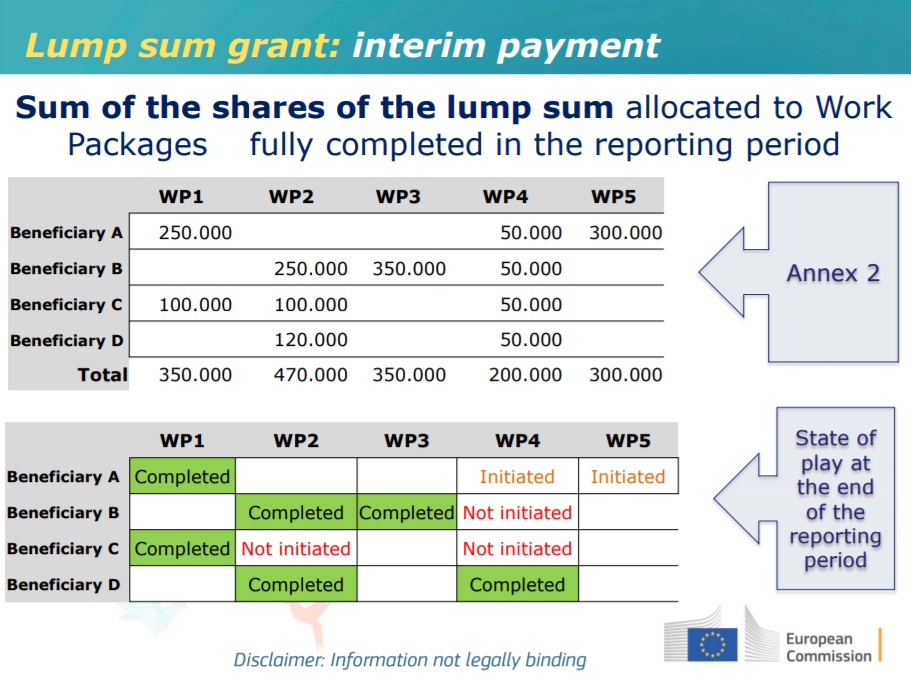
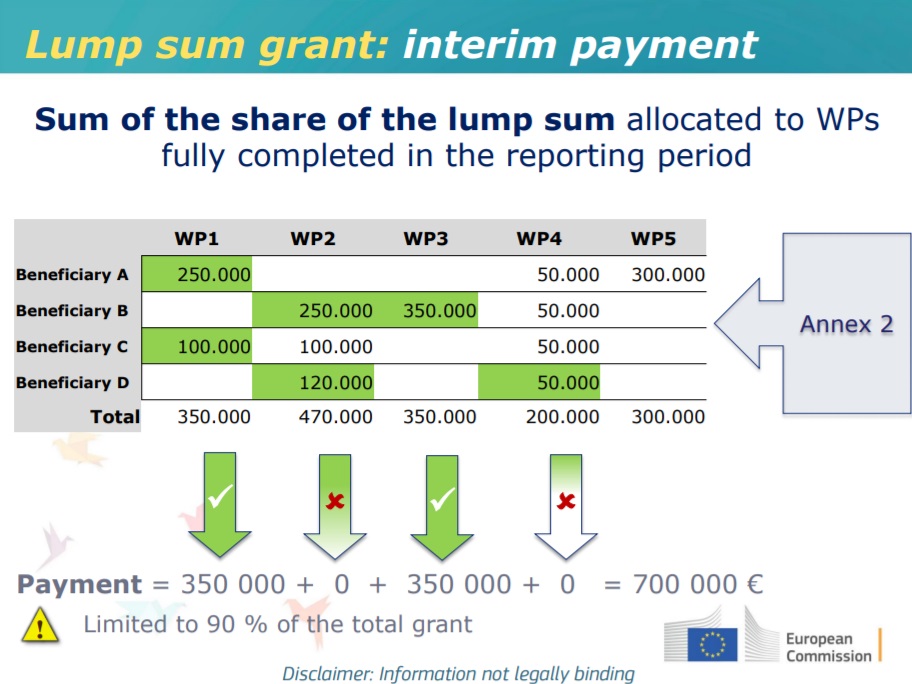
In Annex 2 of the GA the shares of the lump sum per work package and per Beneficiary (and any "affiliated entities") are specified. This also defines the maximum amount of liability of each Beneficiary after the final payment.
What has to be considered especially during the proposal phase?
Particular attention should be paid to the structure of the single work package, as this determines the payment of the lump sum shares. The number of work packages should be appropriate and comprehensible with regard to the project. Horizontal, long-running work packages (e.g. for coordination/management or for dissemination/exploitation) can be split across reporting periods into several work packages.
The standard proposal template for Horizon Europe is used, but for lump sum applications there is a higher page limit (50 pages instead of the standard 45 pages for RIA/IA projects; 33 pages instead of the standard 30 pages for CSA projects).
Type 1b: To define and justify the lump sum amount, a budget table (as Excel file) must be completed and submitted as annex to the Part B of the proposal (instruction for filling-in this budget table). This budget table is used to calculate the lump sum amount based on the estimated actual costs. Only the breakdown of lump sum shares per Beneficiary and per work package is included in Annex 2 of the Grant Agreement (i.e. the completed budget table itself will not become part of the Grant Agreement).
For the evaluation of personnel costs in Lump Sum projects, the EU Commission provides the "Horizon Dashboard for lump sum evaluations" as orientation.
What has to be considered especially during reporting?
The standard reporting template is used. Only work packages declared as "completed" in the reporting period are considered by the EU Commission for payment of the respective share of the lump sum. Completion of a work package is based on the full implementation of the activities in that work package according to the project description (Annex 1 of the Grant Agreement) (i.e. a successful outcome is not necessarily required). Work packages that are not fully completed may be completed in subsequent reporting periods. In the final report, partially completed work packages may be reported (partial acceptance is at the discretion of the EU Commission).
There is no financial reporting as in traditional Horizon Europe Research and Innovation Actions. However, a simplified "Financial Statement" is automatically generated in the Funding & Tenders Opportunities Portal and submitted to the EU Commission.
Which thematic areas allow for lump sum funding and where do I get information about the application?
Our thematic NCPs provide more information.
Further information
Questions & Answers
Question: Are there any differences in project evaluation?
Answer: The evaluation criteria for Lump Sum projects are identical to the standard criteria (excellence, impact, implementation). The cost estimate/budget table is assessed as part of the criterion "implementation". If the estimated costs are deemed inappropriate, the evaluators may propose an appropriate budget in the "Evaluation Summary Report". Over- or underestimated costs will lead to a lower score. The standard briefing document for evaluators include a section on the evaluation of Lump Sum proposals (slides 64-80).
Question: What happens if costs change after grant signature?
Answer: As soon as the lump sum is fixed in the Grant Agreement, the EU Commission will not question any later cost changes (e.g. for goods and services).
Question: Will lump sum shares be paid for only partially completed work packages?
Answer: According to articles 22.3.3 and 22.3.4 of the Grant Agreement, in principle, only fully completed work package trigger payment by the EU Commission. However, during the final payment, the EU Commission may decide on a case-by-case basis to accept partial payment for work packages that were not fully completed.
Question: Are budget transfers possible during the project implementation?
Answer: Yes, but in Lump Sum projects, budget transfers always require an amendment to the Grant Agreement. Additionally, budget transfers between work packages are subject to two conditions:
- The budget transfer must not affect work packages already completed and declared, AND
- the budget transfer must be justified by the technical project implementation.
Question: Are there any checks/audits by the EU Commission?
Answer: Yes, but no financial audits. There still might be checks/audits related to the proper implementation of the project (e.g. technical checks/audits) and compliance with other non-financial obligations in the Grant Agreement (e.g. IPR, dissemination).
Question: Which supporting documents are required?
Answer: Documents related to the technical project implementation, to publications/prototypes/deliverables, to the implementation of work by the Beneficiaries (Who did what?), and other documents proving compliance with the Grant Agreement (Annex 1). NOT REQUIRED are e.g. time records, payslips or contracts, description of the depreciation practice, invoices or other documents proving the actual costs incurred.